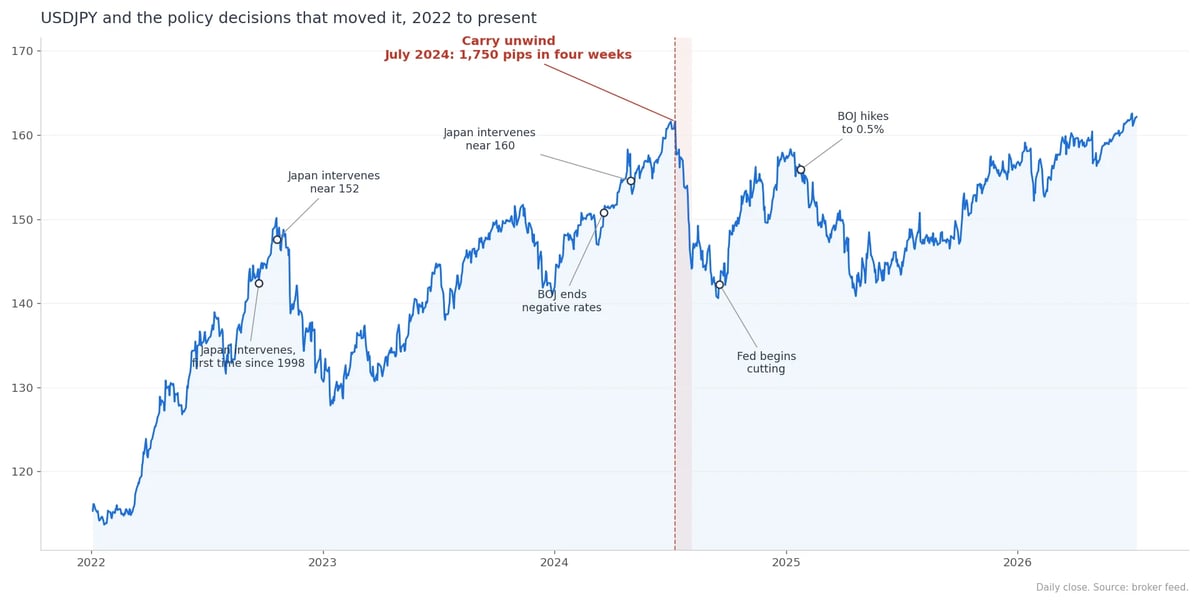
Most currency strategies start with price. Ours starts with policy.
Every major currency pair is, underneath the chart, a relationship between two central banks. The gap between their policy rates decides where capital flows, how fast, and how patiently. That gap does more than nudge the exchange rate. It sets the regime: whether a pair grinds, drifts, or breaks.
USDJPY is the clearest case. For most of two decades the Bank of Japan held rates at or below zero while the Federal Reserve moved through full cycles. The result was one of the most persistent and widely held positions in global markets. When that relationship is stable, the pair tends to range. When it changes quickly, the pair does not correct, it unwinds. July 2024 was the reminder: a shift in expectations on both sides of the Pacific, and USDJPY moved further in three weeks than it usually moves in a year.
We treat those two states as different markets. Our research asks one question continuously: which regime is the pair in, and how close is it to changing. The answer comes from the policy trajectory of each central bank and from what the market is pricing ahead of them, not from chart patterns.
Positioning follows from the answer. In a stable regime the system is patient and works the range. As the regime looks likely to turn, exposure is reduced and protection is prioritised over participation. The specific tools that make that decision are proprietary. The logic is not: read the central banks first, then trade what the read allows.