What the market prices before the Fed decides
Why watching what is priced ahead of a meeting tells you more than the meeting itself.
August 29, 2026
Eight times a year the Federal Open Market Committee meets, votes, and announces a decision at two o'clock Washington time. Financial media treats the announcement as the event. Screens go live, commentators count down, and the headline lands.
By then, most of what matters has already happened. The Fed almost never surprises. It telegraphs its intentions for weeks through speeches, minutes, and guidance, precisely because it does not want a two o'clock shock. The market listens, forms a view, and prices it. The meeting confirms the price. It rarely sets it.
If you want to know where policy is going, the place to look is not the calendar. It is the front end of the yield curve.
The front end is a forecast
Short-dated Treasury bills and money-market instruments mature in weeks or months. Their yield is, almost entirely, a bet on what the Fed's policy rate will average over that period. A three-month bill yielding a quarter point below the current policy rate is the market saying, with real money, that a cut is coming inside the quarter. A bill yielding above it says the opposite.
This is not a signal in the technical-analysis sense. It is the aggregated judgement of the deepest and most liquid market in the world about the single most important interest rate in the world. It updates every day, and it moves before the committee does because the committee's own communication moves it.
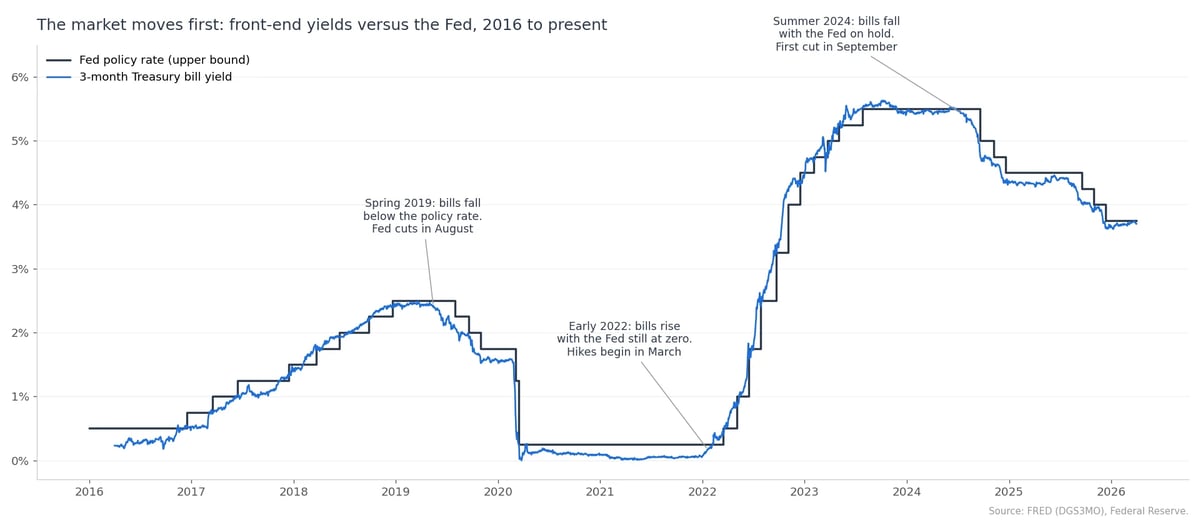
The result is a simple and durable pattern: at turning points in the cycle, the front end leads and the Fed follows.
Three turns, one pattern
Spring 2019. The Fed had raised rates nine times and was signalling patience. By May, three-month bills were trading below the policy rate. The market had decided the next move was down. The first cut came on 31 July. Anyone waiting for the meeting was two months late.
Early 2022. The policy rate was still at zero. Inflation was running at forty-year highs and the Fed's language was shifting. Bills started climbing in January, well before the first hike in March, and kept climbing ahead of every subsequent move. Through the entire hiking cycle the front end ran ahead of the committee. The meetings were a lagging record of what bills had already priced.
Summer 2024. The Fed had been on hold above five percent for a year. In June, bills were near the policy rate. By mid-September they had fallen more than half a percentage point while the Fed had not moved. The market had cut. The committee caught up on 18 September with a larger-than-usual half-point move, which was less a surprise than an acknowledgement.
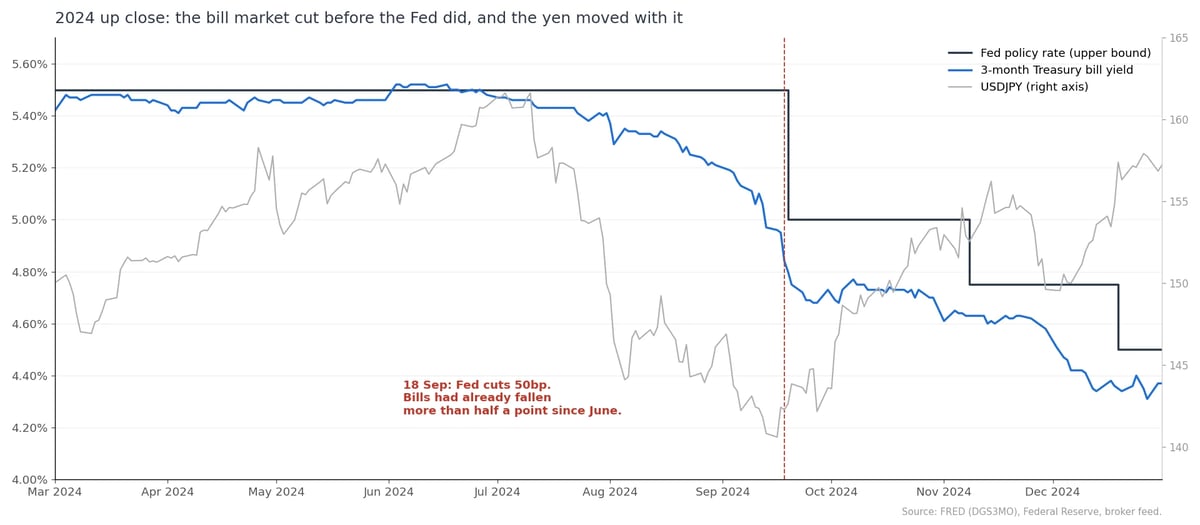
Three cycles, three directions, one behaviour. The front end is a better guide to the next six months of policy than the last statement is.
Why this matters more for USDJPY than for most things
For a currency pair whose entire story is the spread between two policy rates, the expected spread matters more than the current one.
The carry trade in USDJPY does not pay you the current gap between the Fed and the BOJ. It pays you the expected gap over the life of the position. When the front end of the US curve starts pricing cuts, the expected carry shrinks before a single cut is delivered, and positions built on that carry start to feel less comfortable. The chart above shows it: through the summer of 2024, as bills fell, so did the pair, and by the time the Fed acted the yen had already moved twenty figures.
This is why the September 2024 decision itself was not the risk event for USDJPY. The risk event was the six weeks before it, when the market repriced the entire path of Fed policy and the BOJ moved in the opposite direction. A trader watching the meeting saw a 50-point cut and a modest reaction. A trader watching the front end saw the regime change in June.
What to watch, and what not to
What matters is the gap between what is priced and what the policy rate currently is, and the direction that gap is moving. When the front end sits well below the policy rate and is falling, easing is coming whatever the next statement says. When it sits above and is rising, so is tightening. When the gap is small and stable, the regime is stable, and the meeting will most likely confirm it.
What does not matter much is the meeting-day reaction. It is noise around a price the market set weeks earlier. Trading the announcement is trading the residual, the part the market got slightly wrong, and it is a poor use of attention when the larger move was visible in advance.
The same logic applies in Tokyo. The BOJ is less transparent than the Fed and its market is thinner, but Japanese money markets and swap curves price its path in the same way, and they moved ahead of every step of the normalisation that began in 2024.
What we take from it
Regime comes before direction, and policy sets the regime. That is the whole of our framework, and this is where it gets its data. The two central banks tell you where they are going, and the front end of each curve tells you how much of that the market has already accepted. Read together, they describe the spread the market expects, and the expected spread is what USDJPY trades.
We watch that continuously. The specific way it enters our decisions is proprietary. The principle is not: by the time the committee votes, the useful information has already been in the price for weeks, and a process that waits for the vote is a process that is always late.
Precision Pulse Capital publishes research commentary for educational purposes. Nothing here is investment advice, a recommendation, or an offer. Trading foreign exchange on margin carries a high level of risk, including the possible loss of all capital.