July 2024: anatomy of a carry unwind
What happened in the four weeks USDJPY fell 1,750 pips, and what it means for any strategy that assumes ranges hold.
August 29, 2026
On 10 July 2024, USDJPY closed at 161.6, its highest level since 1986. Four weeks later it closed at 144.1. On the way down it touched 141.7 in a single Asian morning that also produced the worst day for Japanese equities since 1987 and a spike in global volatility that had nothing, on the surface, to do with the yen.
Nothing about that move was random. Every leg of it was a policy event before it was a price event. This is the sequence, as it happened, and what it should teach anyone running a strategy that depends on markets behaving the way they behaved last month.
The setup: the most crowded trade in the world
By the summer of 2024 the Fed had held its policy rate above five percent for a year. The BOJ had only just left negative territory in March and was sitting at a tenth of a percent. The gap between them was the widest it had been this century.
That gap paid people to be long USDJPY. Borrow yen at almost nothing, hold dollars at five percent, collect the difference every day. Japanese households, global macro funds, systematic strategies, and a great deal of leveraged fast money were all on the same side of it. Tokyo had intervened twice in the spring to slow the climb. It kept climbing.
A crowded trade is comfortable right up until the moment everyone tries to leave. The question was never whether the position would unwind. It was what would make it start.
The sequence
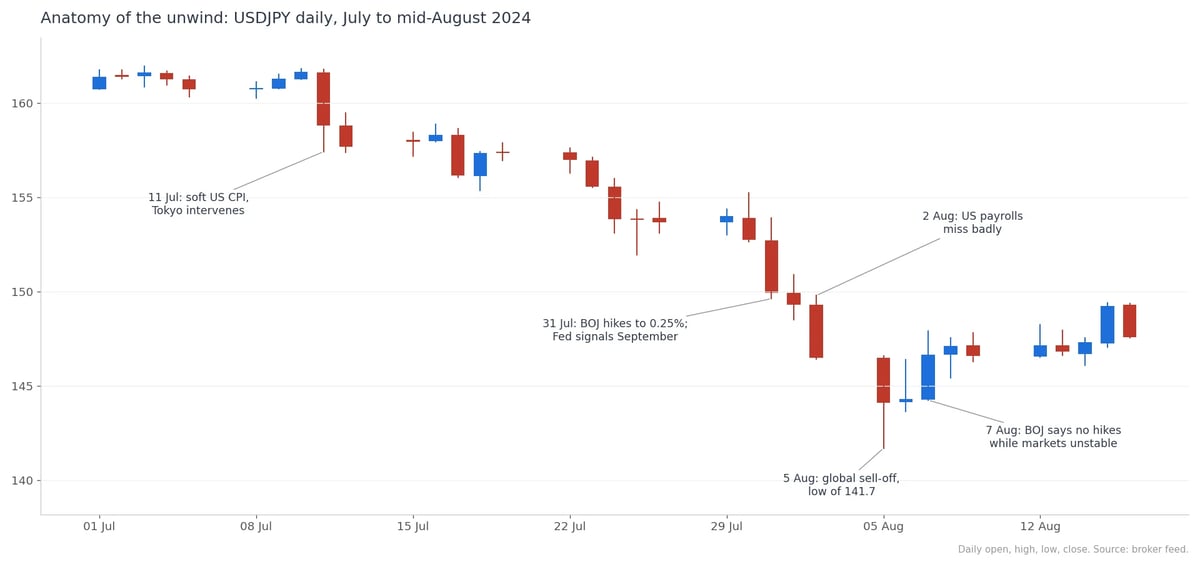
11 July. US inflation data came in softer than expected. The market moved to price earlier Fed cuts, and within minutes Japan's Ministry of Finance intervened, selling dollars into the move. The pair fell four yen in a day. The carry had just been told, from both sides, that its best days were behind it.
Late July. Price drifted lower for two weeks as positions were trimmed. Nothing dramatic. This is what an orderly reduction looks like, and it is easy to mistake for a normal pullback.
31 July. The BOJ raised its policy rate to 0.25 percent and laid out a plan to halve its bond purchases. The same evening the Fed held, but its chair said a cut in September was on the table. The spread that had been wide and stable for two years was now expected to close from both ends at once.
2 August. US payrolls missed badly and the unemployment rate rose enough to trigger a widely followed recession indicator. Fed cut expectations jumped again. USDJPY fell through 147.
5 August. Monday in Asia. With the spread collapsing and no bid under the pair, the unwind became disorderly. USDJPY traded from above 146 to below 142 before Europe opened. The Nikkei fell more than twelve percent, its worst session since October 1987. Volatility spread into US equities, credit, and anything else that had been funded in yen.
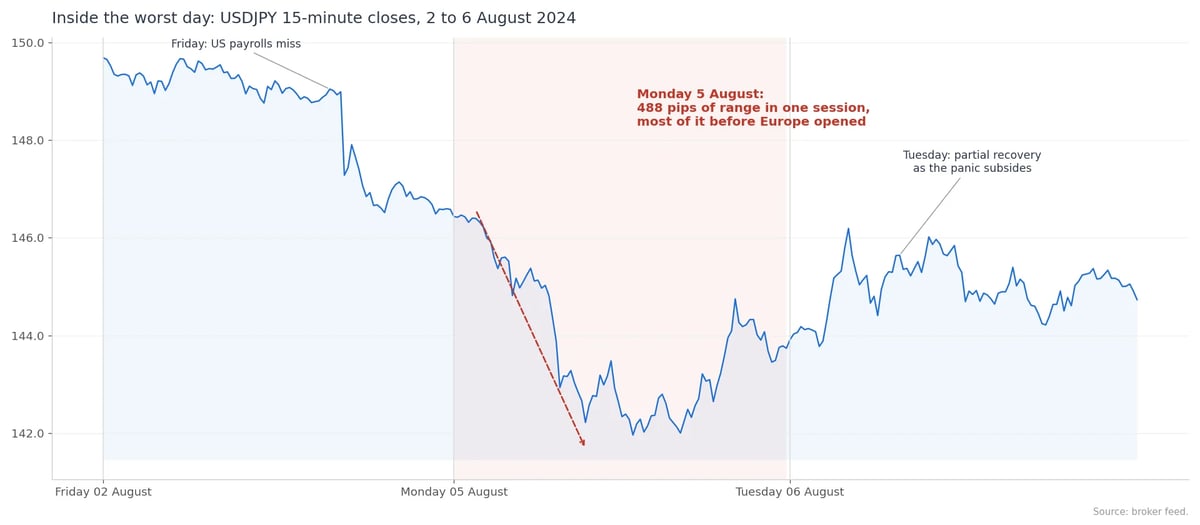
7 August. A BOJ deputy governor said the bank would not raise rates while markets were unstable. That single sentence stopped the fall. The pair recovered several yen over the following days, and the acute phase was over.
Four weeks from peak to trough on daily closes. Roughly 1,750 pips. Closer to 2,000 measured to the intraday low.
What it looked like from inside a range strategy
Any strategy built on the assumption that USDJPY oscillates would have spent July doing what it does well. Every dip was a level to add at. Every partial recovery was a chance to take profit. Through the first three weeks the drift lower was gradual enough that this kept working.
The problem with that is structural, not tactical. A range strategy accumulates exposure as price moves against it. That is the mechanism by which it earns in a range: it buys lower, sells higher, and gets paid when price comes back. When price does not come back, the same mechanism means the position is largest exactly when the market is moving fastest.
On 5 August, a strategy that had been adding since 161 was holding its maximum exposure into a session that moved nearly 500 pips in a few hours, with liquidity thin and spreads wide. Whatever protective logic it had needed to work under those conditions, not the conditions of the previous month.
That is the lesson, and it is not a comfortable one. The failure of a range strategy is not a series of small losses. It is one large loss, arriving at the point of maximum exposure, in a market that has stopped behaving. The question that decides whether a strategy survives is not how it performs in the range. It is what it does in the four weeks when the range stops existing.
Why it was visible in advance
None of this was predictable to the day. All of it was foreseeable in kind.
The spread had been the whole story of USDJPY for two years. The BOJ had been signalling since March that it intended to normalise. The Fed had been moving toward cuts since the spring. The position was famously crowded. The Ministry of Finance had already intervened twice. Anyone reading the two central banks, rather than the chart, knew by June that the regime was fragile and that the exit, when it came, would not be orderly.
What the chart showed in June was a strong uptrend near its highs. What the policy trajectory showed was a carry trade whose foundations were being removed by both central banks at once. Those are different pictures, and only one of them told you what August would look like.
What we take from it
We treat July 2024 as the reference case. It is the scenario every part of our process has to answer for: not the average month, but the month the regime breaks.
Three things follow.
The first is that regime comes before direction. Whether the pair is oscillating or running determines which tools work, and that state is set by policy, not price. Reading the central banks is not colour commentary. It is the primary input.
The second is that exposure has to be governed by where the regime is, not by where price is. In a stable spread, patience and accumulation are rewarded. As the spread comes under pressure, the priority shifts to protection, and it has to shift before the market forces it.
The third is that any protective logic has to be tested against this episode specifically. A system that survives the average drawdown and fails on 5 August has not been tested. The specific tools that make those judgements are proprietary. The standard they are held to is not: if it would not have survived July 2024, it does not run.
Precision Pulse Capital publishes research commentary for educational purposes. Nothing here is investment advice, a recommendation, or an offer. Trading foreign exchange on margin carries a high level of risk, including the possible loss of all capital.